
Case of the Month – Calming Plantar Fasciitis


This month I’m writing about Donna and her plantar fasciitis. We started working together after her C section earlier this year and mostly focused on core rehab. This week’s session shifted to her feet, specifically her right. She’s currently 12 weeks pregnant and fighting a lot of fatigue.
She came in with pain localized to the arches of her feet and not the calcaneal insertion points of the plantar fascia. With palpation both calves were tight and tender. Donna also confessed to having a long history of excessive supination when walking due to periodic arch pain. She also has a previous history of right sided piriformis tension that we’ve been working on.
With the progesterone rising in her body, my thoughts are that she is reaching an earlier tipping point of ligamentous laxity in her feet vs. weight gain. Additionally, since this second pregnancy is on the heels of her first. Her first child is about 7 months old and she hasn’t completely recovered in regards to musculoskeletal changes, especially the piriformis tension and glute weakness.
Due to Donna’s fatigue, I kept her in supine to keep things less taxing. Here’s what we did in her 30 min treatment session:
1) Gentle gastroc release with a bit of gua sha and manual release bilaterally (5 min)
2) Reformer: Footwork for Lower and Lift and Running (which can be found in my Foundational course). I followed with some arch massage with arches on the Footbar, legs straight, and moving through reciprocal plantarflexion and dorsiflexion. (5 min)
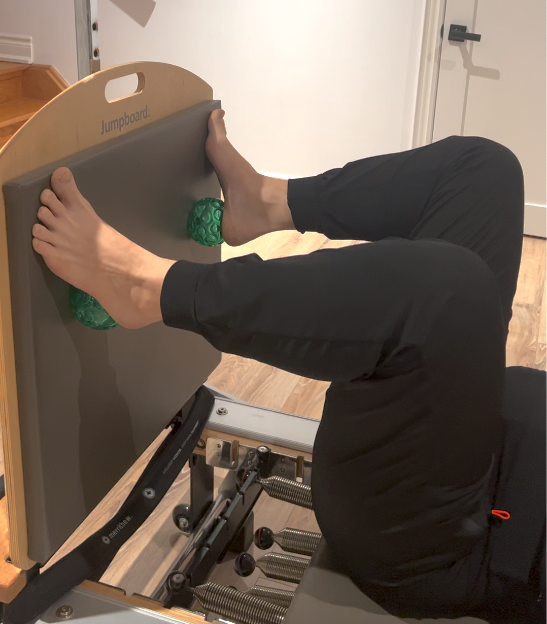
3) Reformer with Jump board for controlled footwork with heels on Franklin balls (a soft, lightweight ball with textured grip)
For this entire series, I gave Donna lots of cueing for keeping the balls pinned but not squished against the Jump board. I also emphasized placing equal weight between the medial and lateral contact points of the forefeet.
- Wide second position with turn out for basic leg press.
- Narrow second position in parallel, feet further down the Jump board and therefore requiring more length through the tendoachilles.
- No balls, gentle calf raises with knees extended as well as flexed.
- Leg presses with no balls under heels in second position parallel. Lots of cueing to maintain heel contact with the Jump board for as long as possible through active dorsiflexion.
This Jump board series was about 10-12 minutes. See the sequence here on Instagram.
4) Gait retraining: A quick minute of gait retraining to encourage less excessive supination and finding a more grounded foot. This was also an opportunity to get a post-treatment re-assessment (2 min).
5) Homework: Plantar fascia roll out with massage ball + Eccentric calf raises with body weight supported in prone standing (from my old neuro days, this is standing at the kitchen counter with upper body resting on the countertop) to reduce load. Cues for keeping the feet and ankles in neutral. (1 min)
Want a more in depth walk through for all the above exercises? It’ll be in my Postpartum and Pelvic floor course.
Also, if you’re interested in more Clinical Pilates content, here are a few ways that I can help you:
See some of my favourite exercises and sequences that I use everyday with my clients.
2) Reformer Pilates Integration Guide
My free guide for those in the early stages of planning/implementing Reformer into their workspaces.
3)Benefits and Logistics of Reformer in Clinical Practice
Watch my free webinar hosted on Embodia about how and why I use Reformer in my physio practice.
4)Clinical Reformer Integration Playbook
A collection of 7 treatment templates for common orthopedic conditions and how to structure your Reformer sessions. Suitable for those with and without Reformer training.
5)Foundational Reformer for Rehab
My clinically-minded comprehensive Reformer training course with everything you need to get started.


leave a comment