
An Unexpected Exercise for Anterior and Posterior Pelvic Tilt with Reformer Pilates


This month I’m sharing one of my favourite multi-tasking exercises. I first developed it for posterior pelvic tilt (PPT) but it’s also proven helpful for anterior pelvic tilt (APT). While it really started out as a hip flexion strengthening exercise, it’s evolved into something far more useful.
Most recently, I’ve implemented this with a virtual client who I’ll call Tessa. She has a history of Hypermobile Ehlers-Danlos Syndrome (hEDS), left shoulder impingement, thoracic kyphosis with PPT, and a childhood surgery for her right leg leading to decreased limb length and reduced ROM and strength on that side. Tessa also has a few other medical concerns, but I’ll be leaving those details out for brevity.
Tessa’s primary treatment goals included improving her posture. Like many people with PPT (myself included!), we’ve been working on hamstring and gastroc lengthening, deep core activation and endurance, spinal extension strength and endurance, thoracic mobility, and scapular stability. Tessa also struggles with knee control to avoid hyperextension.
As a die-hard efficiency nerd, this flow combines all of these! Pressing the standing leg into hip extension through the entire series is a real hamstring burner 🔥. There’s a lot going on with these exercises so feel free to layer slowly or spread them out through a few sessions.
This is by far my longest article and I hope you find all the details helpful, but after reading this back to myself, it’s very wordy. So if you somehow get through the whole series and find yourself scratching your head, I would suggest just trying it 🙃.
Here’s the 5-part flow:
Set-up: 1 medium/1 blue/0.5 springs, Gearbar and Stopper set all the way in at 1:1.
Starting position: Stand on the floor beside the Carriage and facing the back of the Reformer. Place one knee on the Carriage against the near shoulder rest and place hands on the ipsilateral rail. Press the kneeling leg into hip flexion to push Carriage out.
General Focus: Maintain spinal and pelvic neutral while activating the standing leg’s hamstrings and glutes, deep core, and shoulder(s). When the kneeling hip flexes, the standing leg has opportunity to extend reciprocally. Keep an eye out for any knee hyperextension and keep the spinal extensors and deep core working in the background to maintain neutral spine and pelvis. There’s also endurance work for scapular stability in closed chain and the obliques and lats jump in towards the end of the flow.
For PPT: Let’s assume your client demonstrates some glute gripping, short and weak hamstrings, and weaker core deep core and spinal extensors. Cue for isometric hip extension in closed chain with a hamstring and gastroc stretch as you move through the series. Flexion of the contralateral hip is intended to create a dynamic hinging challenge when it’s tempting to grip through the glutes and tuck into PPT when the knee moves forward. We’re forcing the proximal hamstrings and lower glutes to strengthen in a lengthened position in concert with the spinal extensors and deep core. All of this to pull out of PPT.
For APT: So what about APT people? I’m going to approach this for the common presentation of tighter hip flexors with a weaker core and hamstrings/glutes. With activation of the glute and hamstrings on the standing leg, cue for deep core control to avoid tipping into APT. The hip that is flexing should help maintain neutral as only the standing leg is moving through hip extension. The idea is that strengthening the hamstrings in a lengthened position will provide a decent challenge. While putting the hip flexors in a shortened/relaxed position should facilitate downregulation of them. We can also strengthen the core here without the hip flexors trying to help (I’m looking at you, TFL).
1) Hip Flexion: Press the Carriage out with hip flexion with the kneeling leg, while reciprocally pressing isometrically through hip extension in the standing leg. Although the focus is the standing leg, flexing the opposite hip helps stabilize the pelvis and prevent slipping into PPT and lumbar flexion OR APT and lumbar extension. This is the time to nail down neutral spine and pelvis.
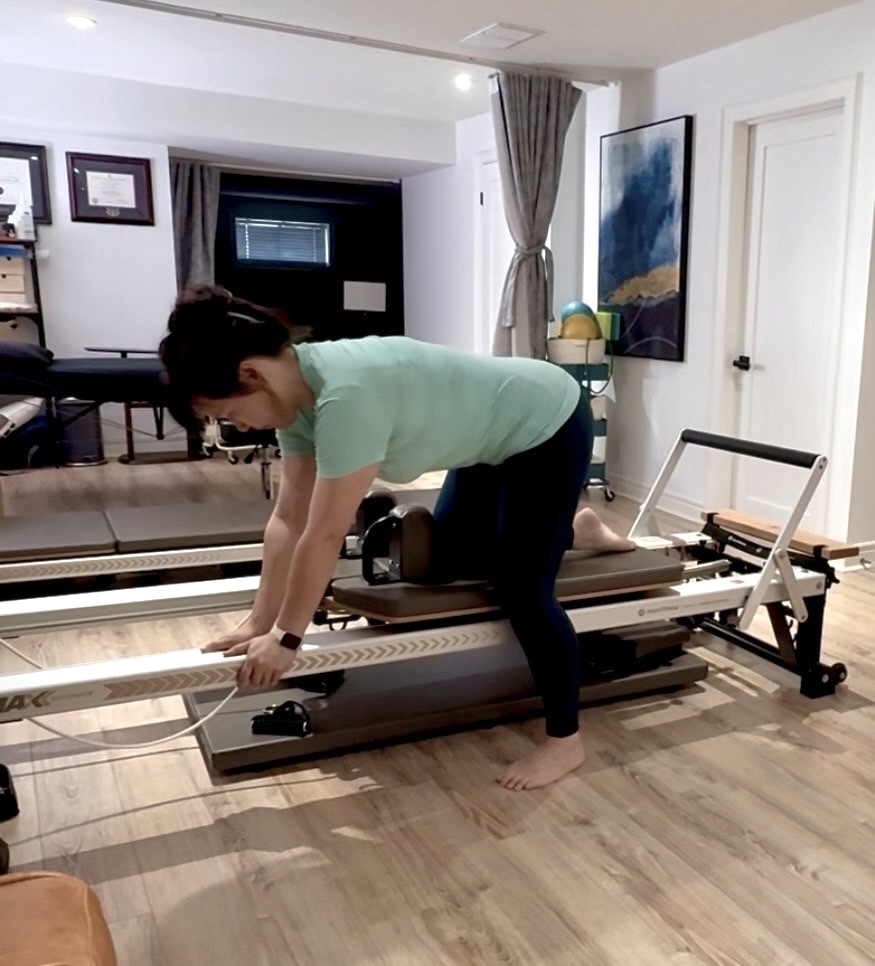
2) Single Arm Support: Lift the hand on the Carriage side and place it into Salute position. Continue to press the Carriage out. This should layer on more deep core and scapular protraction with only one arm on the rail.
3) Add Trunk Rotation: Continue with the hip flexion and add on left trunk rotation by reaching the raised elbow toward the supporting one. You can see me add a touch of flexion with this to turn on the obliques a bit more. This is great for addressing stiffness in the thoracic spine for any APT people, and increased thoracic kyphosis for PPT people.
4) Add More Trunk Rotation: Swap the supporting arm, and continue with left trunk rotation to get more range and switch up the obliques. I find that closed-chain obliques are often overlooked and they are so important when it comes to core stability.
5) Connect the Lats to the Hamstrings: Lastly, move the supporting arm further away on the rail to loop in the posterior sling/spiral line.
As a PPT-er, My physio frequently tells me I need to work my left hamstrings and this flow is infinitely more fun than an elevated reverse plank.
Watch the full flow on Instagram.
Are you a clinician looking to add Reformer Pilates to your toolkit? Check out my Foundational Reformer for Rehab course. Now eligible for physio CEUs in all 50 states in the U.S.


leave a comment